A quote that gets no reply is not a rejection. It is usually one of three things: the decision maker was not in the conversation, the number landed without context, or the client simply meant to reply and did not.
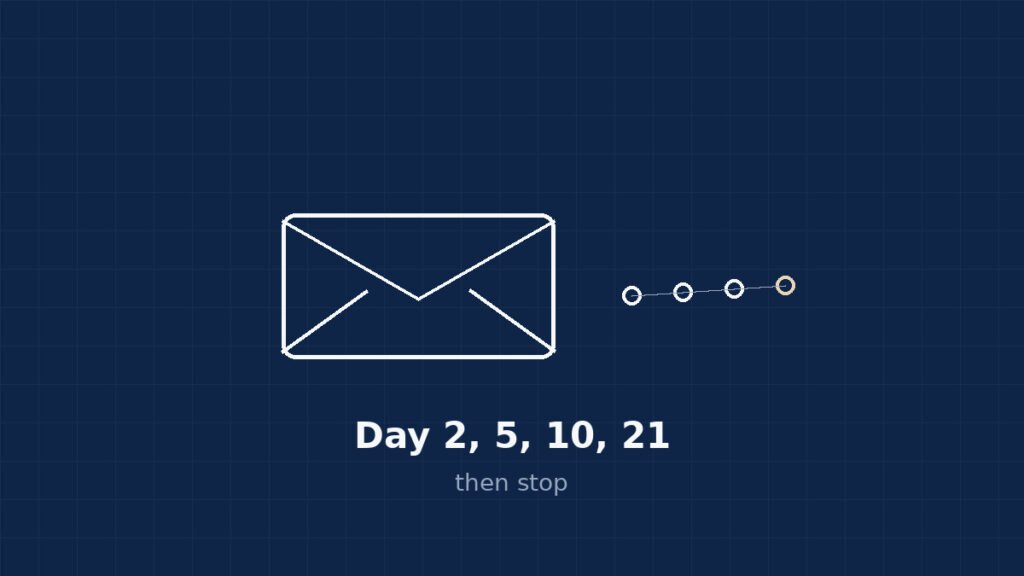
Most businesses respond to silence by doing nothing, then quietly counting the job as lost. The ones that win a third more work do something less dramatic: they send four short emails over five weeks, each with one job to do, and then stop.
Why quotes go quiet
Nobody owned the decision
You quoted the person who answered the phone. They are not the person who signs. A follow-up that asks “is this something you are deciding on, or should I send it to someone else?” solves a week of silence in one line.
The number arrived without a story
A figure on its own reads as expensive. A figure next to what it replaces, what is included, and what happens if it is not done reads as a decision. If your quote was a single total, the follow-up is where you add the context you should have sent.
The timing was wrong and they were polite
“Let me think about it” often means “not this month”. That is not a lost client, it is a client with a date. The follow-up that asks “is this a this-month decision or a next-quarter one?” gets a real answer where “any updates?” gets nothing.
The line that kills a follow-up before it starts
Anything that begins with “just checking in” or “just following up” tells the client you have nothing to add and are asking them to do the work of replying. It also makes you sound like every other supplier in their inbox.
Every message below has a reason to exist beyond your own curiosity. That is the whole trick.
The four messages, and when to send them
Message one, two working days later: confirm it arrived
Short, no ask beyond confirmation. This one exists to catch the quote that went to spam or the wrong address, which happens more often than anyone admits.
Subject: Your quote for [job] - did it arrive?

Hi [name],

Just checking the quote for [job] reached you - I know attachments sometimes get filtered.

If it did, no action needed. If you would rather I sent it as a link, tell me and I will resend it that way.

[your name]
[phone]
Message two, day five: add the thing they are actually weighing
This is the message that wins work. Do not repeat the price. Answer the question they are too polite to ask: why this figure, or what happens if they choose the cheaper option.
Subject: The part of the quote people usually ask about

Hi [name],

One thing I did not explain well in the quote: the [specific item, e.g. 8 sheets of decking allowance] is included because [reason]. Without it, [consequence].

If your decision is between us and a lower quote, that line is usually where the difference sits - happy to walk through it on the phone in five minutes if that helps.

[your name]
Message three, day ten: give them a date
Silence often means “no deadline”. Quotes should have one, and this is where you say it kindly. A date also protects you: you cannot hold a slot forever, and saying so is professional rather than pushy.
Subject: Holding [date] for you until Friday

Hi [name],

The quote is valid until [date]. I have kept the [day] slot open until then, because two people asked about the same week.

If you want it, reply "go ahead" and I will confirm the start date. If the timing is wrong, tell me roughly when you would want it and I will re-quote closer to that date.

[your name]
Message four, day twenty-one: close the loop cleanly
This one gets answers because it asks for a decision rather than a favour. It also ends the sequence with dignity, whether or not they say yes.
Subject: Closing your quote for [job]

Hi [name],

I am tidying my quotes for the month, so I will close this one unless it is still live for you.

Three options, pick whichever is true:
1. Go ahead - I will confirm the start date.
2. Not now - tell me when and I will come back to you.
3. Not us - no hard feelings, and thank you for considering it.

Either way, thanks for the chance to quote.

[your name]
If they did say “too expensive”, one reply that keeps the door open
Do not discount immediately. Ask what the budget is and offer a smaller scope at that number, because reducing scope protects your rate while reducing price does not.
Thanks for telling me straight - that is more useful than silence.

If [budget] is the number that works, I can do [reduced scope] for it, which covers [what it covers]. Same workmanship, smaller first phase.

If that is not the right fit either, happy to be second call next time you need [trade].
Four rules that decide whether any of this works
- Reply on the same thread. A new subject line makes them hunt for context, and they will not.
- One ask per message. Two questions in one email gets one answer, usually the easier one.
- Five lines maximum. Long follow-ups read as pressure. The quote is already long; the nudge should not be.
- Three attempts, then quarterly. After message four, put them in a list you contact every three months with something useful. Chasing a fifth time costs you the relationship you might have kept.
The tracking that makes this automatic
The sequence only works if you know which quote is on message two. That is a list, not a memory: client, amount, date sent, next action date. A spreadsheet is fine. So is the quote builder, if you keep the outputs in one folder.
Set the next date the moment you send the quote, not when you remember. If the job is worth $2,000, the two minutes to schedule the follow-up is the highest-paid work you will do that day.
Three prompts for writing these faster
Write a day-five follow-up email for a quote I sent for [job] at [amount]. The client went quiet after I sent it. Include one sentence explaining the part of the quote people usually question ([specific line item]), and one question I can answer on the phone in five minutes. Maximum 90 words, no "just checking in", plain English.
Here are my notes on a client: they said "it is more than I expected" after a [amount] quote for [job], and I think their budget is around [budget]. Write three options: a reduced-scope version at their budget, a phased version, and a polite close that leaves the door open. Give the price logic for each in one line so I can check it.
Turn these into a four-message follow-up sequence for a quote sent today: [paste quote details]. Give me day 2, day 5, day 10 and day 21 emails with subject lines, each under 90 words, each with exactly one ask, in the voice of a one-person [trade] business that does not want to sound desperate.
Questions people ask about follow-ups
How many times should I follow up on a quote?
Three follow-ups after the quote, then stop and move to a quarterly check-in. Four messages over five weeks is the point where persistence starts costing you goodwill.
Should I follow up by email or phone?
Email first, because it leaves a record and can be read at their convenience. Add a phone call after message two if the job is large enough to justify it. One call, not a campaign.
What if they say they went with someone cheaper?
Ask one question: what would have made the difference. The answer is worth more than the job, and it costs you nothing to hear it. Then stay in touch quarterly, because cheap suppliers get replaced when they stop turning up.
Is it worth following up on a small quote?
Only if the same effort gets you the same fee. For a small job, one email at day five and one at day twenty-one is enough; the full sequence is for work that pays for the time it takes.
Related guides
- Free estimate template for Google Docs, Word and Excel
- Callout fee: what to charge and how to say it
- Payment reminder email templates
- How to chase an overdue invoice
- Best free invoicing software
- Pricing and getting paid: every guide
Last reviewed and updated on November 16, 2026.