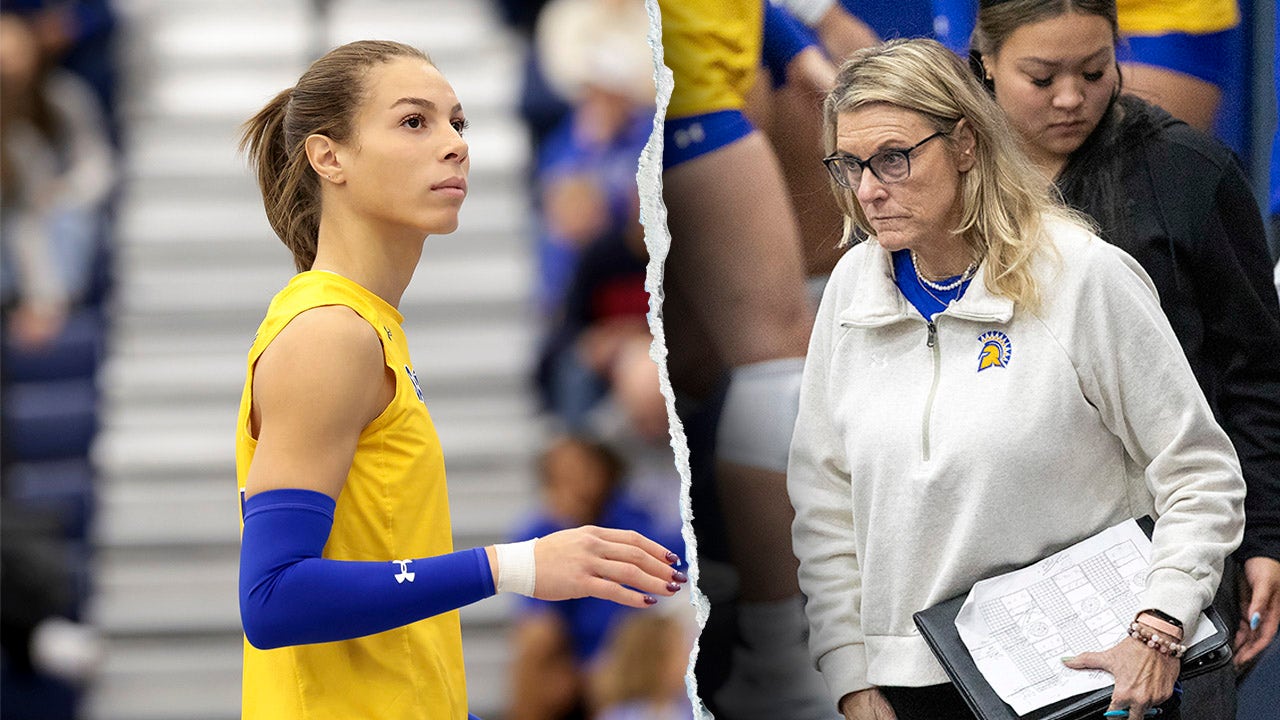
Ex-SJSU volleyball coach files new lawsuit alleging retaliation for Trump support, religion amid trans scandal

EXCLUSIVE: Former San Jose State University volleyball assistant coach has filed a new lawsuit over her alleged treatment during and before the school’s scandal involving transgender athlete Blaire Fleming and female teammate Brooke Slusser. Melissa Batie-Smoose filed an initial lawsuit last October, but it was dismissed in September.
But she’s not backing down, and is now making new allegations about what happened before she was suspended and eventually let go from her position.
Her new complaint alleges that SJSU head volleyball coach Todd Kress mocked her for supporting Donald Trump in front of players, reacted with hostility to her religious objections to a transgender athlete’s participation, and made her feel “physically unsafe” during certain interactions.
The complaint alleges she repeatedly told Kress, “in substance,” that “God made man and woman” and that her beliefs prevented her from treating a male athlete as female. She claims Kress responded with hostility toward those beliefs and disparaged her politics.
CAMPUS CONFLICT EXPOSED AT THE CORE OF SJSU’S MESSY FIGHT VS TRUMP ADMIN OVER VOLLEYBALL SCANDAL
“Kress would also berate her during practice in front of the athletes, calling her ‘Trump-loving’ or a ‘Trump lover’ and mocking her political affiliation,” the complaint states.
Associate head coach Melissa Batie-Smoose with the San Jose St. Spartans as they play Air Force in an NCAA women’s volleyball game at Spartan Gym in San Jose, Calif., on Thursday, Oct. 31, 2024. (Santiago Mejia/San Francisco Chronicle via Getty Images)
Elsewhere, the filing alleges that Kress knew she was a Republican who had voted for Trump and used those remarks to damage her relationship with players, excluded her from meetings and reduced coaching duties.
The relationship at the center of the new complaint began well before the controversy.
Batie-Smoose says she worked with Kress at Florida State in 2006 and again at Fairfield University from 2019 through 2022. When Kress moved to San Jose State, she accepted the associate head coaching position and relocated her family from Connecticut to California in January 2023.
Batie-Smoose has previously alleged she learned that Fleming was transgender only after arriving in 2023.
Over the next two seasons, Batie-Smoose says, disagreements about Fleming’s participation became entangled with her relationship with Kress, her responsibilities on the court and her standing inside the athletic department.
One alleged confrontation described in the complaint began with a canceled recruiting visit.
In approximately August 2023, a hurricane disrupted a recruit’s flight. Batie-Smoose says she returned from the airport to the gym to update Kress, who ignored her greeting twice. After she commented on his behavior, she alleges, he followed her into her office and closed the door.

COLORADO SPRINGS, COLORADO – OCTOBER 19: Head coach Todd Kress of the San Jose State Spartans looks on during the third set against the Air Force Falcons at Falcon Court at East Gym on October 19, 2024 in Colorado Springs, Colorado. (Photo by Andrew Wevers/Getty Images) (Getty Images)
The complaint says he “cornered, yelled at, and berated her” and told her he could get her fired. Batie-Smoose describes feeling physically unsafe during the encounter.
She says she reported the incident to athletics human resources and an administrator overseeing the program, but “in response, Plaintiff was told that Kress was her boss and that she needed to listen to him. Kress received no disciplinary action for his behavior towards Plaintiff.”
The filing also describes alleged confrontations involving players. OutKick is not disclosing the names of the players.
The complaint alleges Kress berated one athlete “so harshly for not passing her running test that she experienced panic attacks. Plaintiff reported this mistreatment to Alexander. Upon information and belief, Kress was not disciplined.”
It described another alleged incident in which a player was “excoriated by Kress in front of the team for being a few minutes late to the locker room after a losing match. The ferocity of his interaction resulted in both Plaintiff and [the player] informing Alexander about the incident. Upon information and belief, Kress was not disciplined.”
The new complaint also separately cites an older accusation against Kress.
Fox News Digital reported in July that a former Fairfield player had accused Kress of a 1998 hotel-room assault.
Batie-Smoose’s filing alleges that the former player notified SJSU in October 2024 and that an official acknowledged her stated safety concern. It argues that the university’s handling of that report supports her claim of disparate treatment.
“Plaintiff is further informed and believes, based on public reporting, that Defendant took no further action following this correspondence, and that Kress continued to coach and travel with the SJSU women’s volleyball team without interruption or restriction. Plaintiff alleges that Defendant’s handling of this report is consistent with, and corroborates, the pattern of disparate treatment against Plaintiff alleged throughout this Complaint,” the lawsuit states.
On Oct. 29, 2024, Batie-Smoose submitted a Title IX complaint alleging unequal treatment and failures to address concerns inside the program regarding the transgender athlete and the female players on that year’s team. Days later, the university placed her on paid administrative leave.
According to her new lawsuit, her punishment arrived on Nov. 2, about 90 minutes before a home match: a university administrator blocked her entry to the gym, required her to surrender her identification and keys, and instructed her to leave. She alleges she could not retrieve belongings from her office. The filing includes an attachment of her suspension letter.
The letter referenced a complaint against Batie-Smoose dated Oct. 24 — five days before her own Title IX submission. The allegations included differential treatment based on a protected status, disclosure of confidential student information, drinking with athletes during team travel, unprofessional or insubordinate conduct, inappropriate language and a failure or refusal to coach athletes.
The letter prohibited campus access and contact with student-athletes and imposed restrictions on discussing the investigation, with exceptions including legal counsel and a union representative.
Batie-Smoose alleges the university used the accusations as a pretext and enforced its rules differently against her than against Kress.
She denies improperly disclosing protected education records and says the information she discussed came from public sources or personal observations.
Batie-Smoose acknowledged having a drink in an airport lounge while adult players were present, but says she neither purchased their drinks nor encouraged them to drink. She alleges another male coach was drinking there without facing the same consequences.
She also denies directing inappropriate language at players or refusing to coach an athlete for whom she had responsibility.
On Jan. 31, 2025, athletics director Jeff Konya notified her that her temporary coaching appointment would not be renewed, in a letter issued on behalf of President Cynthia Teniente-Matson.
Batie-Smoose’s latest lawsuit was filed Oct. 13 in the Northern District of California, the lawsuit names the California State University trustees and 11 university employees, including Kress, after a legal setback in September.
On Sept. 4, Judge Noël Wise dismissed Batie-Smoose’s previous amended complaint, which asserted discrimination and retaliation under Title VII and Title IX.
Wise found that the allegations did not plausibly connect the suspension or nonrenewal to Batie-Smoose’s sex or protected advocacy. The order emphasized the complaint’s account that the university acted after she disclosed student information to the media despite instructions to keep it confidential.
“Plaintiff’s complaint supports that she was disciplined for violating a confidentiality law, not for opposing discrimination on the basis of sex,” Wise wrote. The ruling granted leave to amend within 21 days, so now Batie-Smoose and her attorneys have escalated their fight with a trove of new allegations.
SJSU and CSU have declined to provide responses to Batie-Smoose’s latest complaint.
INSIDE THE FALLOUT OF THE SJSU VOLLEYBALL SCANDAL: ‘THIS IS AN OBVIOUS PROBLEM’
“Due to pending litigation, San Jose State is unable to comment,” an SJSU spokesperson told OutKick.
A CSU spokesperson responded, writing, “The CSU is not commenting at this time. We were made aware of the lawsuit yesterday and are still reviewing the claims.”
The new complaint comes as SJSU and CSU find themselves in the midst of a mult-front legal battle with Batie-Smoose, former athletes, and President Donald Trump’s administration over the scandal.
On Jan. 28, 2026, the Education Department’s Office for Civil Rights issued a findings letter addressing SJSU’s volleyball program. The letter, attached to Batie-Smoose’s new complaint, concluded that the university violated Title IX in its treatment of athletic participation, sex-separated facilities and the handling of discrimination complaints.
On employment and scholarships, the letter expressed compliance concerns and identified evidence it considered indicative of unequal treatment, while acknowledging gaps in the records.
Some of the most consequential passages concern the university’s handling of its two coaches.
OCR reported that personnel investigations involving Batie-Smoose and Kress were opened on Nov. 12, 2024, and questioned why the university suspended her but not him. The letter cited investigator notes stating that Kress “crossed the FERPA line in his interview with ESPN,” referring to the federal student privacy law.
The letter also described internal records suggesting officials worried that suspending Kress could “spark more media attention” and “unduly disrupt the team.”
The lawsuit, citing those passages, argues that privacy and team stability were applied selectively.
CSU disputes that comparison. Its March complaint against the Education Department argues that the coaches were not similarly situated, that Batie-Smoose disclosed protected information, and that an investigation found insufficient evidence that Kress retaliated against Slusser. The system also challenges the federal investigation’s procedures and conclusions.
Meanwhile, CSU’s disagreement with Washington has become a lawsuit of its own.
The university system sued the Education Department on March 6, arguing that the government was attempting to punish SJSU retroactively for conduct consistent with the law, federal guidance and NCAA rules in effect during the 2022–24 seasons.
CSU declined the federal government’s proposed resolution agreement. It maintains that protecting transgender students and complying with then-governing rules did not amount to unlawful sex discrimination.
Federal officials threatened enforcement that could put funding at risk. But a March 31 court order established protections against funding disruption based on the challenged findings.
The legal landscape has also changed since the 2024 season.
On Feb. 6, 2025, the NCAA changed its policy to restrict competition on women’s teams to athletes assigned female at birth, following Trump’s executive order the previous day. The policy permits athletes assigned male at birth to practice with women’s teams under specified conditions.
On June 30, 2026, the Supreme Court upheld the challenged restrictions in West Virginia and Idaho, ruling that Title IX and the Equal Protection Clause permit schools to reserve female teams based on biological sex.
The court expressly left unresolved a separate question: whether schools may allow transgender women and girls to participate on female teams. That limitation matters in the SJSU dispute, where permission to exclude and a legal obligation to exclude are different issues.
In March, a Colorado federal judge dismissed the Mountain West defendants from the lawsuit brought by Slusser, Batie-Smoose and other volleyball players. The court found that the conference was not subject to Title IX and was not a state actor for the constitutional claims. It also dismissed several claims against university officials, while deferring a ruling on Title IX damages claims against the CSU trustees pending the Supreme Court’s decision. Supplemental briefing continued after that decision.
For Batie-Smoose, the latest suit seeks both compensation and restoration of her professional standing.
She requests reinstatement to her former job or a comparable position, back pay and other compensatory relief, punitive damages against individually liable defendants, legal fees and a jury trial. She also asks for removal or correction of adverse personnel records, including the suspension letter, the later evaluation and an October 2025 nondiscrimination-policy finding. The complaint specifies no total damages figure.
She has returned to coaching elsewhere. Cisco College announced her appointment as head volleyball coach in April.
CLICK HERE TO DOWNLOAD THE FOX NEWS APP
But her new filing asks a court to revisit the place she left: the gym entrance where she says her work was interrupted, the personnel file that followed, and the university decisions that she alleges converted a dispute over women’s sports into the loss of her job.
CSU has disputed the broader accusations against SJSU. In its own litigation against the Department of Education, the university system says it followed the law and athletic eligibility rules applicable during the seasons at issue, protected student privacy and investigated complaints.
It also says an investigation found that Batie-Smoose discriminated against Blaire Fleming because of sex and gender identity. Batie-Smoose contests the university’s findings and denies refusing to coach any athlete.