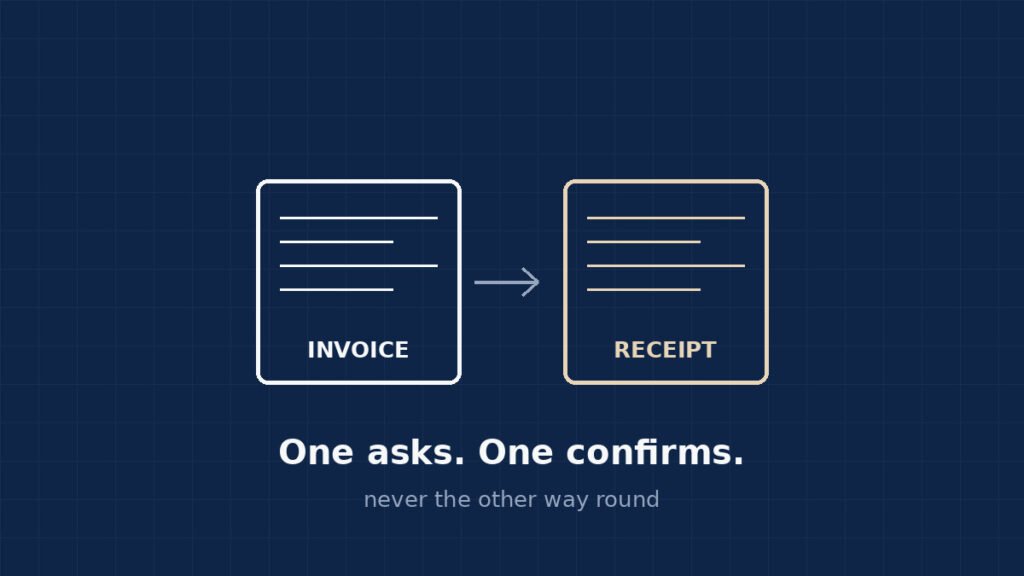
An invoice asks for money. A receipt confirms it arrived. That is the whole difference, and almost every confusion about the two comes from a business using one when the client needed the other.
Getting this wrong costs small businesses real money: a receipt issued before payment is a document that says the client already paid, and a client who has one will say so.
The one-line difference
An invoice is a request. It lists what you did, what it costs, and when payment is due. It exists before the money.
A receipt is a confirmation. It states that payment was received, how much, on what date, and by which method. It exists after the money.
If you send a receipt when work is done but unpaid, you have handed the client proof of a payment that never happened. That is the single most expensive version of this mistake.
Side by side
                INVOICE                         RECEIPT
Issued          before payment                  after payment
Purpose         ask for money                   confirm money received
Sent by         the seller                      the seller
Proves          what is owed                    what has been paid
Number          INV-2026-014                    RCP-2026-014
Key fields      due date, payment terms         payment date, method
Client action   pay it                          keep it
Invoice, receipt, statement: three different things
These three get mixed up constantly, and the mix-up is usually in the client’s head rather than yours.
Invoice
A request for a specific sum, for specific work, with a due date. One job, one invoice, one number.
Receipt
Proof that a specific payment landed. If a client pays an invoice in two parts, you can issue two receipts against one invoice.
Statement
A summary of everything outstanding over a period, usually monthly, for clients who have several invoices open. It is a reminder, not a demand for one specific sum.
A commercial client with an accounts department often wants a statement rather than individual invoices, because they reconcile monthly. A household client wants neither: they want one invoice and a confirmation when it clears.
What belongs on each
On the invoice
- Your business name, address and any tax or company number your jurisdiction requires
- The client’s name and address, and a purchase order number if they use one
- A sequential invoice number, never reused
- Issue date and due date, with payment terms stated in words
- Line items: description, quantity, unit price, line total
- Subtotal, tax, total, and the currency
- How to pay: bank details, payment link, or both
- What happens if it is late, if you intend to charge for that
On the receipt
- Your business name and the client’s name
- The invoice number it settles, and its own receipt number
- Amount received, and whether it is full or partial
- Date of payment, and the method: card, transfer, cash
- Who received it, if it was cash
- A single line stating what it covers
A receipt can be one paragraph in an email. It does not need to be a designed document, but it does need those fields, because its only job is to be evidence.
The situations that actually come up
The client asks for a receipt but means an invoice
Common with clients who pay by bank transfer and need paperwork for their own accounts. Ask one question: “Is this so you can pay it, or so you can file it as paid?” The answer tells you which document to send, and it takes four seconds.
You took a deposit
Invoice for the full job, then a receipt for the deposit amount against that invoice, then a receipt for the balance. Never a receipt for a deposit with no invoice behind it, or the total is impossible to reconstruct later.
The client needs it for reimbursement
Expense systems usually want a receipt, and often want the invoice too. Send both in one email, with the invoice first, and name the files by invoice number so they stay together.
You need to correct one
Do not edit and resend the same number. Issue a credit note against the invoice and a fresh invoice with a new number. An edited document with an old number is the kind of thing that turns a small mistake into an audit problem.
Two habits that prevent the argument
One number sequence per document type. Invoices run 001, 002, 003. Receipts run in their own sequence. The moment numbers overlap between types, you cannot prove which document came first, and the client’s version of events becomes as good as yours.
Never issue a receipt before the money clears. Not on a promise, not on a screenshot, not on “the transfer is on its way”. If the payment fails, you have a document saying it did not, and no clean way to withdraw it.
Both habits are free. Both are also the first things a bookkeeper asks about when they take over your files.
How long to keep them
Retention rules vary by country and by tax status, and they change. In many places the requirement for business records sits somewhere between four and ten years, and digital copies are accepted if they are complete and readable. Check your own jurisdiction rather than trusting a general guide, including this one, because the penalty for being wrong lands on you.
Three prompts that write these faster
Write a short receipt email for a client who has just paid invoice [INV number] for [job]. Amount [amount], paid by [method] on [date]. Include: invoice reference, amount, date, method, one line on what it covers, and a sentence confirming the balance if it is a partial payment. Under 90 words, plain English.
Here are my job notes: [paste]. Produce two documents: (1) an invoice with line items, subtotal, tax, total and payment terms of [X] days; (2) a receipt template for when it is paid, with the fields that make it valid as proof. Use sequential numbering starting at [INV-2026-001].
My client is asking for "a receipt" for work they have not paid yet. Write a two-line reply that politely clarifies the difference, sends the invoice instead, and tells them they will get a receipt the moment the payment clears. No lecture, no jargon.
Questions people ask
Can an invoice double as a receipt?
Not honestly. Some businesses write “paid” on a copy of the invoice, which works if it shows the payment date and method. A separate receipt number is cleaner, and it is what an accountant will ask for.
Do I need to send a receipt if they paid by card?
The card processor sends one automatically. Yours is still useful if the client needs it for expenses, because the processor’s receipt rarely shows what the work was.
What is the difference between a bill and an invoice?
Practically none. A bill is what the buyer calls it, an invoice is what the seller issues. The document is the same; the word depends on which side of it you stand.
Should a receipt show tax separately?
If the invoice showed tax, the receipt should confirm the total received, and it helps to repeat the tax amount. Where tax is recoverable, the client’s bookkeeping depends on that figure appearing.
Related guides
- Free invoice template for Google Docs
- Invoice template for Word, Excel and Sheets
- Contractor invoice template
- Best free invoicing software
- Payment reminder email templates
- Pricing and getting paid: every guide
Last reviewed and updated on November 21, 2026.