
Rubio says US monitoring Russian plague scare
Secretary of State Marco Rubio, who is traveling to Iceland, Greece and Portugal this week, said the U.S. is closely monitoring reports of a lab worker infected with plague in Russia.
NEWYou can now listen to Fox News articles!
Russian authorities have quarantined a hospital and placed scores of people under medical observation after a 28-year-old employee at a Siberian plague research institute died from a mysterious case of pneumonia, fueling fears — still unconfirmed — that she may have contracted pneumonic plague.
Darya Shipilova worked at the Irkutsk Anti-Plague Research Institute of Siberia and the Far East. Russian health authorities say extensive testing found no evidence that her illness was caused by pathogens linked to her work, but officials have yet to publicly identify what killed her.
The extraordinary precautions surrounding the case have fueled speculation inside and outside Russia. Reuters reported Oct. 5 that all known contacts had been traced and placed under medical supervision and that authorities said no new cases had been identified among employees of the institute.
Secretary of State Marco Rubio said Monday that the U.S. was “watching and monitoring it closely,” adding,”I don’t think it’s cause for alarm, but it is cause for focus and a cause just to keep an eye on it.”
US MONITORING SUSPECTED FATAL PNEUMONIC PLAGUE CASE IN RUSSIA, STATE DEPARTMENT OFFICIAL SAYS
A view of the Medical Assistance and Rescue Centre, an infectious diseases hospital, in the town of Shelekhov in the Irkutsk region, Russia, October 5, 2026. (Reuters)
Rubio said information released by Russia appeared to show “there was a worker at the lab that was infected” and concern that the illness could have spread internally. He noted that travel between Russia and the U.S. is limited but warned that “something like that gets out, it just quickly spreads.”
The comments follow a State Department statement to Fox News on Oct. 4 that Washington was monitoring the case alongside the Centers for Disease Control and Prevention and other federal agencies. The official stressed that many details remained unconfirmed and urged Moscow to provide accurate information quickly.
Additional reporting provided Monday by East2West news agency said more than 60 employees remained confined inside the Irkutsk institute and nearly 200 people who had contact with Shipilova had been placed under observation. Those precise figures have not been officially confirmed. The agency also reported that neighboring countries, including Kyrgyzstan, Uzbekistan and Kazakhstan, had increased border health precautions following the case.
The hospital in Shelekhov, just outside Irkutsk, where Shipilova was treated has been placed under quarantine and temporarily stopped admitting or discharging patients, according to The Associated Press. Irkutsk Gov. Igor Kobzev described the case as a suspected “particularly dangerous infection.”
SCIENTISTS CRACK THE CODE ON NEW VACCINE FOR DEADLY PLAGUE BACTERIA

Darya Shipilova, 28, an employee of the Irkutsk Anti-Plague Research Institute of Siberia and the Far East, died after developing pneumonia of an unknown cause, prompting quarantines and heightened health precautions in the region. Russian authorities say testing has found no evidence her illness was linked to pathogens she worked with. (East2West news)
Adding to the unusual response, Anna Popova, the head of Russia’s public health watchdog Rospotrebnadzor, flew to Irkutsk for an emergency meeting after Shipilova’s death, Reuters reported. A nearby aluminum plant also ordered employees to wear masks as a precaution.
Kremlin spokesman Dmitry Peskov urged the public to rely on official information rather than “rumors or speculation.”
Rospotrebnadzor said Sunday that Shipilova was diagnosed with “pneumonia of unknown etiology” and that testing detected “no microorganisms associated with the patient’s professional activities.” The agency also said an investigation found no laboratory incident involving pathogenic microorganisms.
Pneumonic plague is a severe form of plague caused by Yersinia pestis that can spread from person to person through respiratory droplets during close contact. It can be successfully treated with antibiotics when treatment begins early.
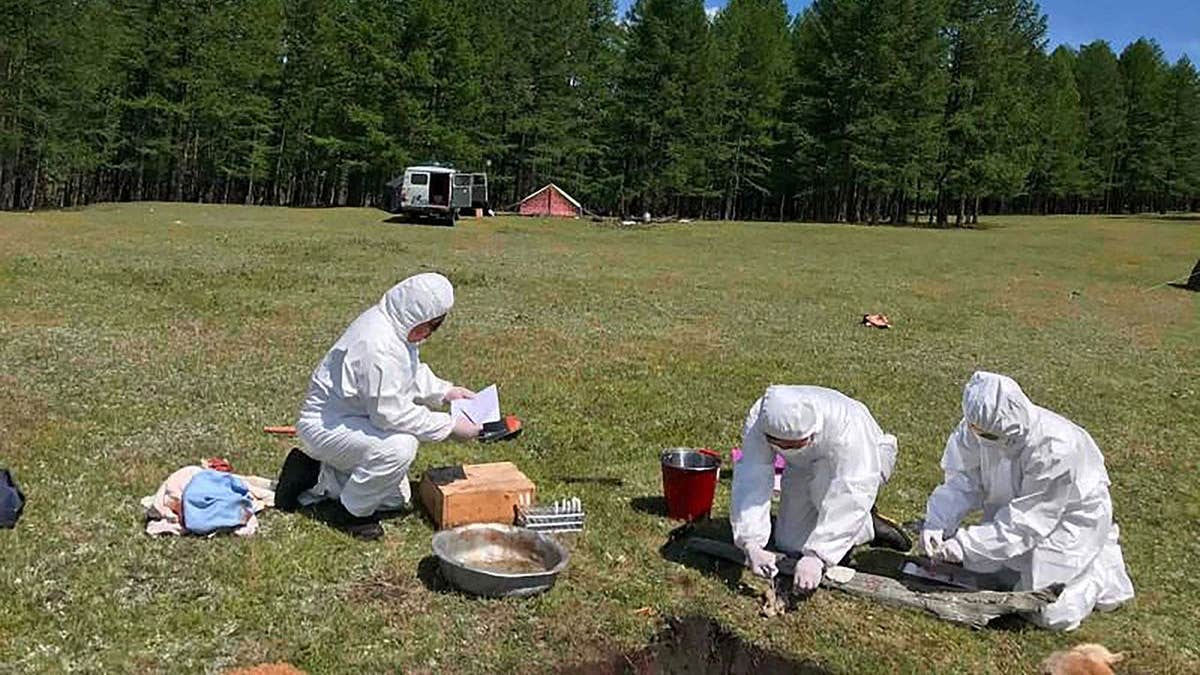
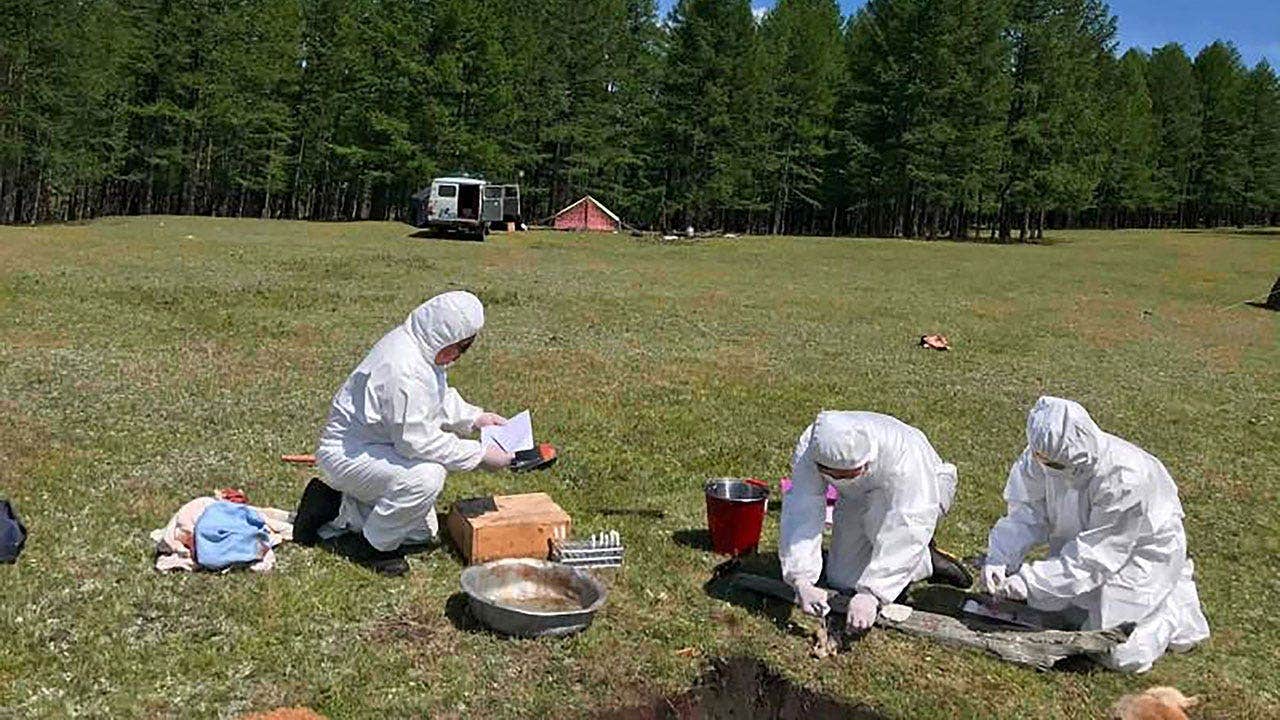
Workers in protective uniforms conduct testing in Russia amid heightened precautions following the death of an employee at a Siberian anti-plague research institute. (Khuvsguliinungu.mn/e2w)
Russian officials continue to insist there is no evidence of a plague outbreak and say the epidemiological situation remains stable. For now, however, the central question remains unanswered: what caused Shipilova’s fatal pneumonia — and why authorities imposed such extensive containment measures if no dangerous pathogen has been detected.